



Tân Phú Curtains Reviewed Through 4 Completed Projects: More About Dividing Spaces Than Blocking Sunlight
What four projects in Tân Phú do and do not tell us
This article is based solely on the four projects Thanh Vy completed in Tân Phú, and nothing more. Four is a small number, and the most honest thing to do with a small sample is to say clearly that it is small, rather than write as though we have understood all the homes in the entire district. Everything below is an assessment drawn from exactly those four sites, along with a frank explanation of what these four projects are not sufficient to conclude. Information about the company also appears in the Thanh Vy premium curtains section on Báo Hà Tĩnh.
If you need a fuller picture of services in the area, the overview is on the Tân Phú curtains page. Here, however, the goal is to work backward from real projects to draw lessons, including lessons that are not helpful for selling.
Three of the four projects used curtains for partitioning, not sun blocking
This is what makes the Tân Phú data very different from the usual assumption. Of the four projects, only one was a home. The other three were two spas and a hospital, and all three installed curtains to divide the space into private sections, not to deal with sunlight coming through windows.
That difference is not as minor as many people think. Window curtains are opened and closed a few times a day, always have a wall and window frame to support them, and being off by an inch or two is difficult to notice with the naked eye. Partition curtains hang in the middle of a room, have no wall for support, are pulled constantly as customers come and go, and if they leave a gap at the bottom or along the edge, privacy is lost immediately. They may both be called fabric curtains, but these two problems require different things in terms of tracks, length, and reinforcement of the hanging points. You can also refer to polyester fibers in the textile industry to better understand the material aspect.
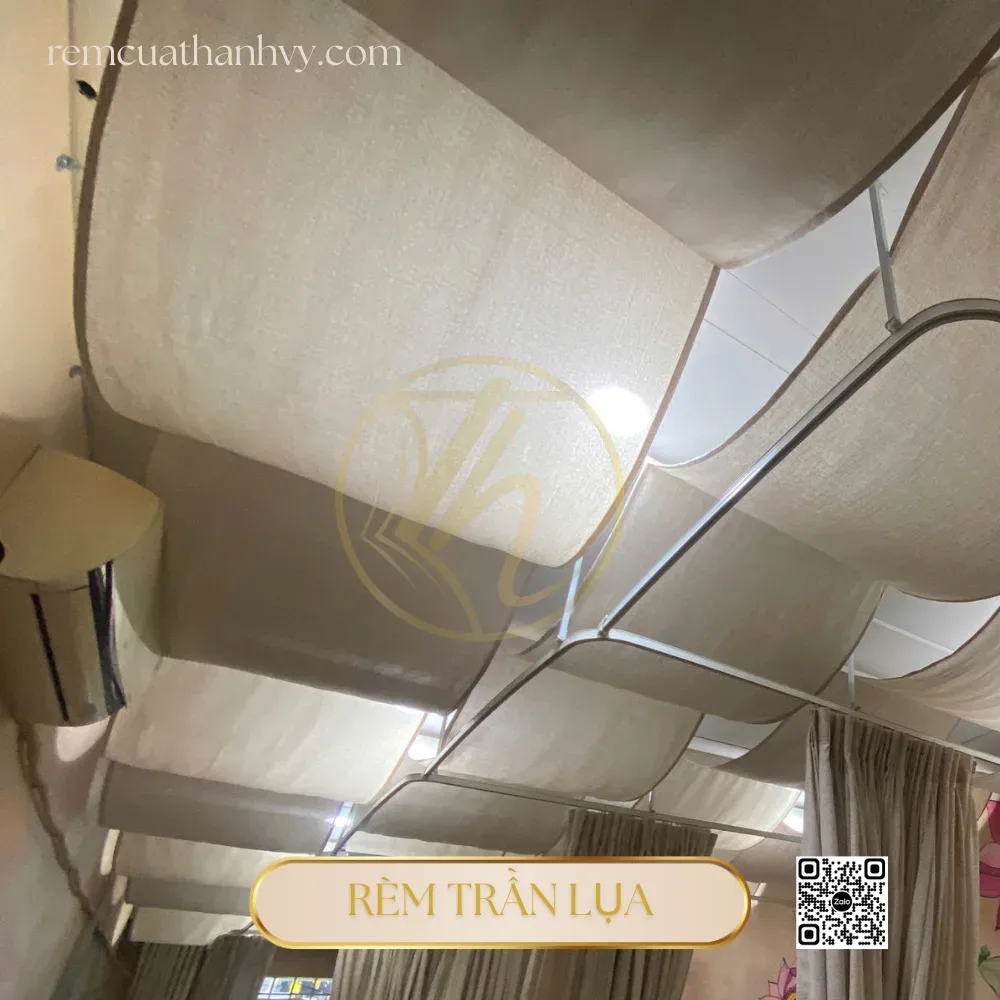
Therefore, the strongest experience left by the four Tân Phú projects is experience with partition curtains. That is both the strength and the limitation of this assessment.
The only residential project: a high-ceiling apartment with a window opening onto a balcony
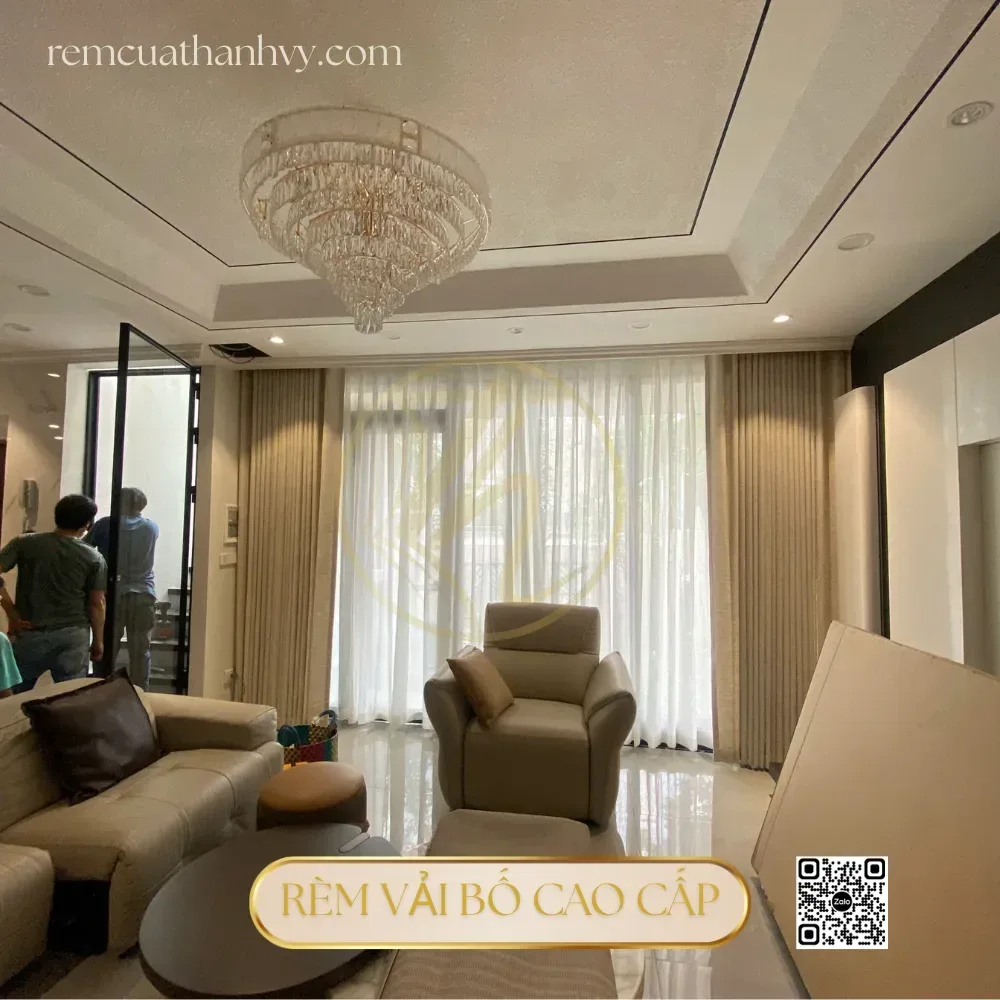
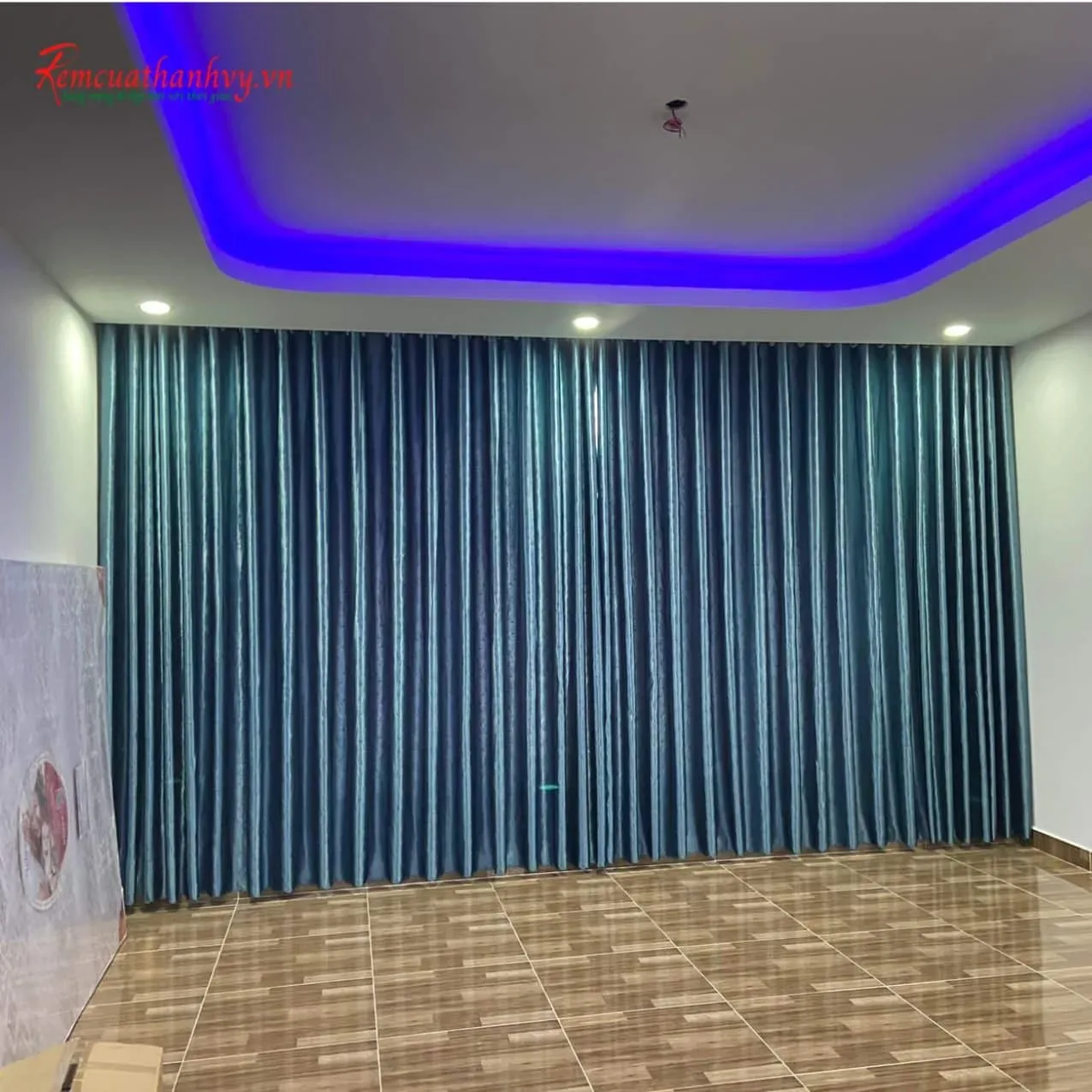
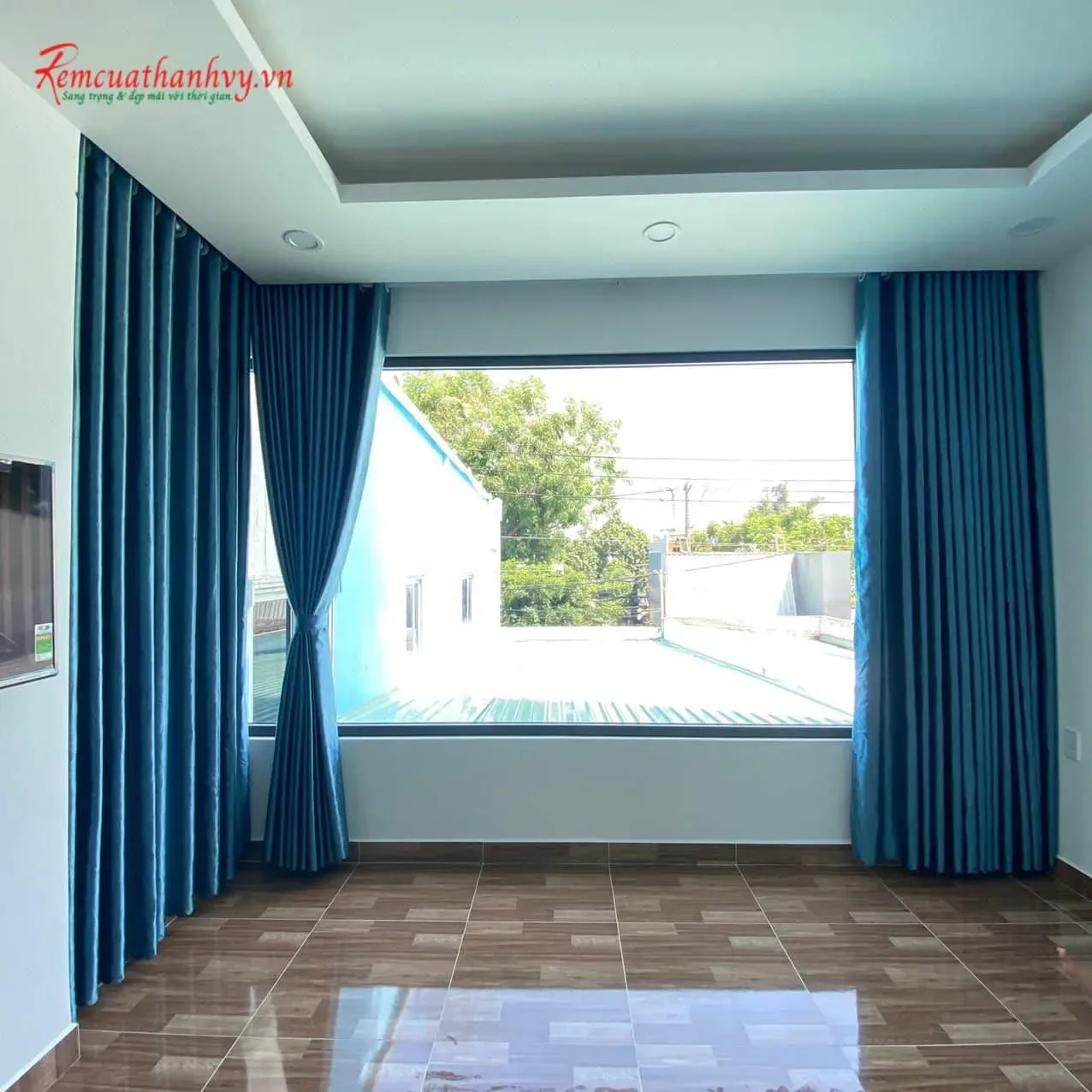
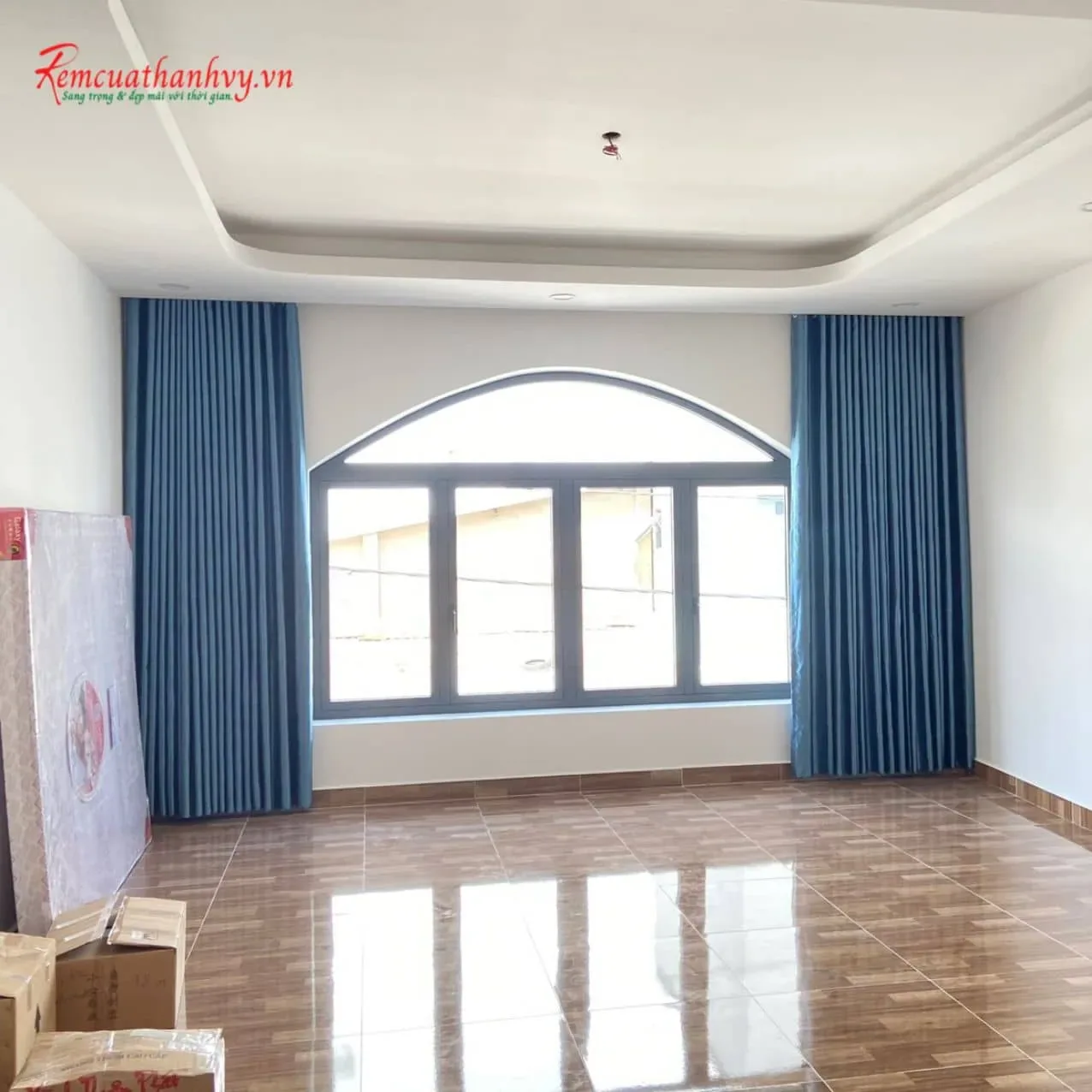
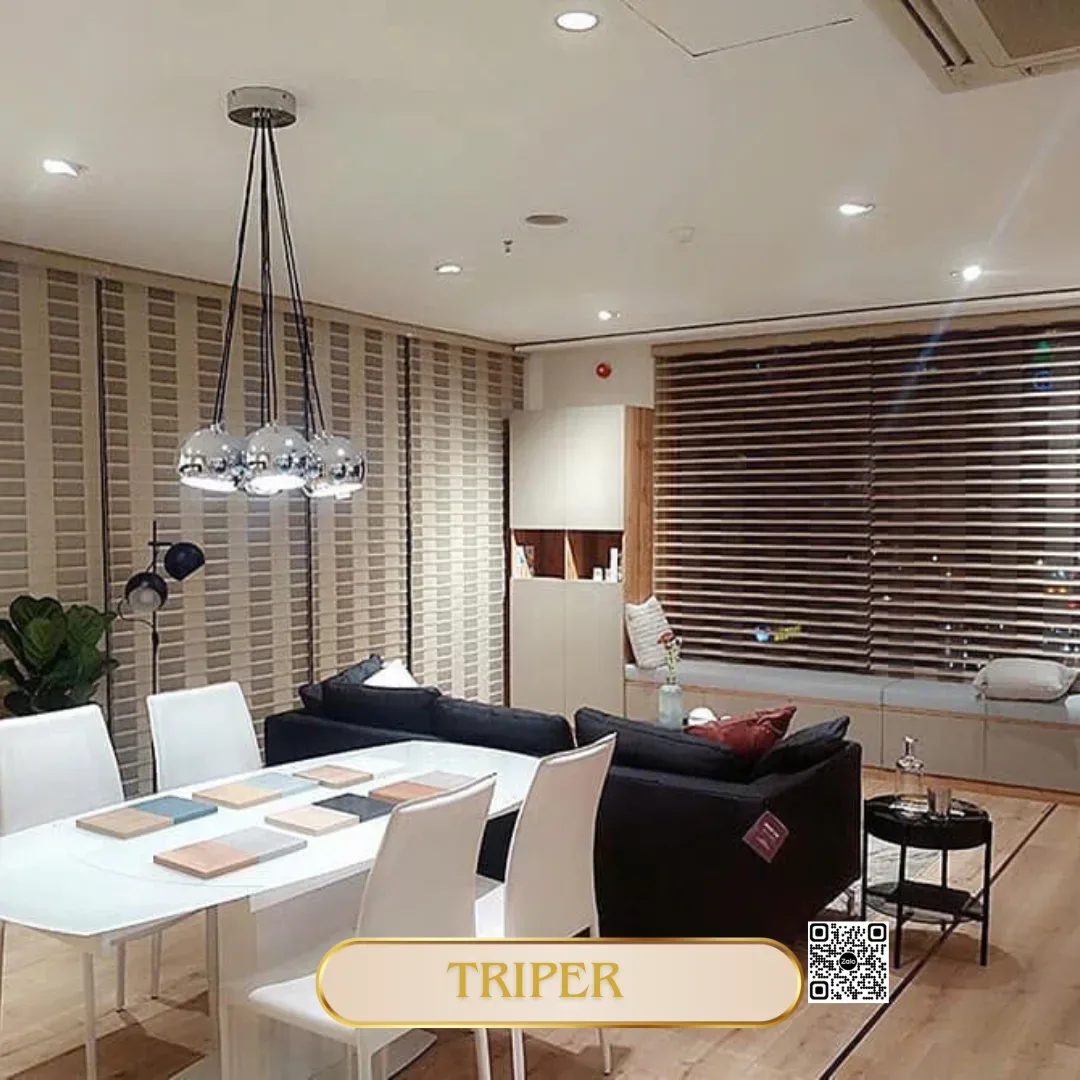
The project featuring blue fabric curtains for the living room of a high-end apartment in Tân Phú was the only residential case in the group. The site was a high-floor living room with a plasterboard ceiling, recessed downlights, wood-look tile flooring, and a large window opening onto a balcony.
The selected configuration was one-way fabric curtains with straight vertical pleats, hung on a track running close to the ceiling. These three decisions worked together: with a high ceiling, the curtains had to start high up so the vertical surface would not be cut across; with a wide window, gathering them to one side saved more space than splitting them in two; and even pleats kept a large expanse of fabric from looking like a tarp. The result showed that the fabric’s drape and pleat lines remained even from top to bottom, with the lower edge touching the floor in a straight line.
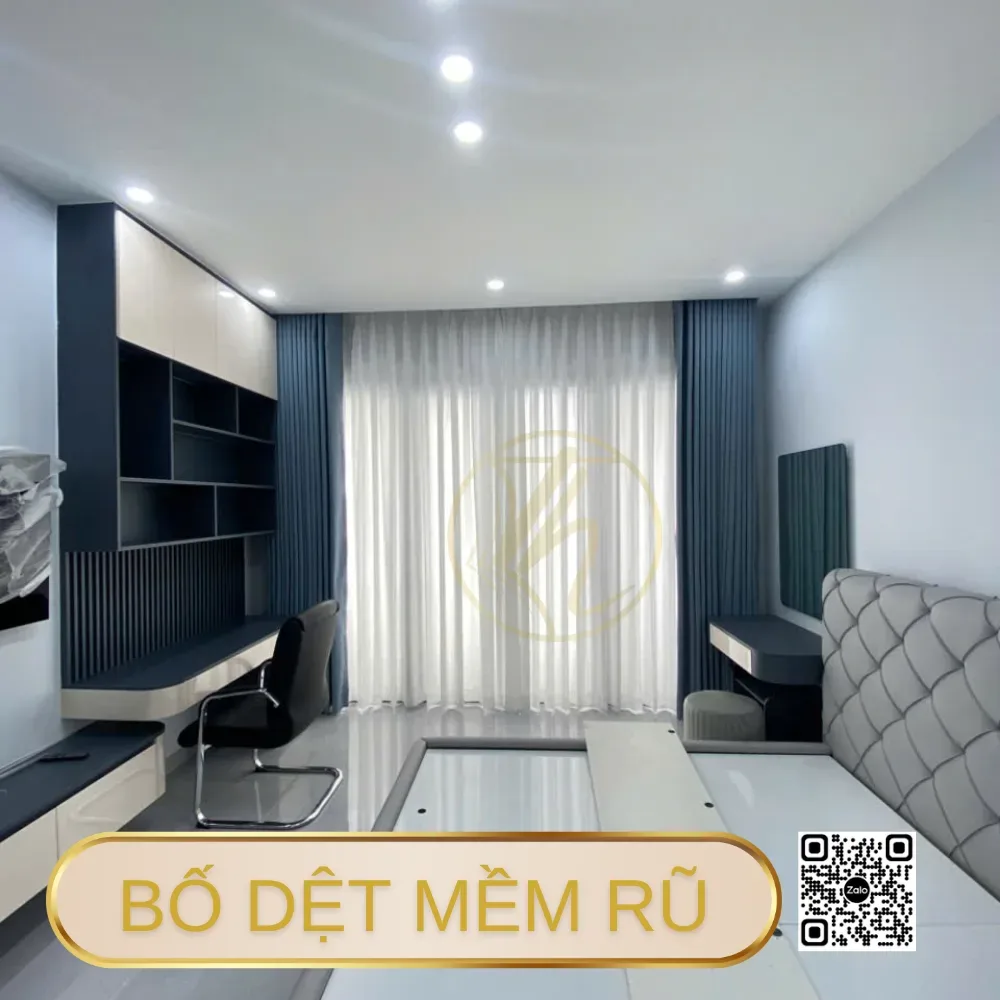
But the part that needs to be stated plainly concerns the color. The deep teal shade works well here because it has supporting context: a gray-white ceiling, cool lighting, and modern furnishings. Move that same color into a living room with cream walls, warm wood flooring, and yellow lighting, and the curtain panel will feel heavy and out of place. A color that looks beautiful in photos of one project is not a formula to reuse elsewhere, and this is the most common mistake when customers choose curtains from pictures.
Two spas in Tân Phú, two completely different ways of partitioning
The two spa projects in the group show that there is no single answer to the phrase spa partition curtain.
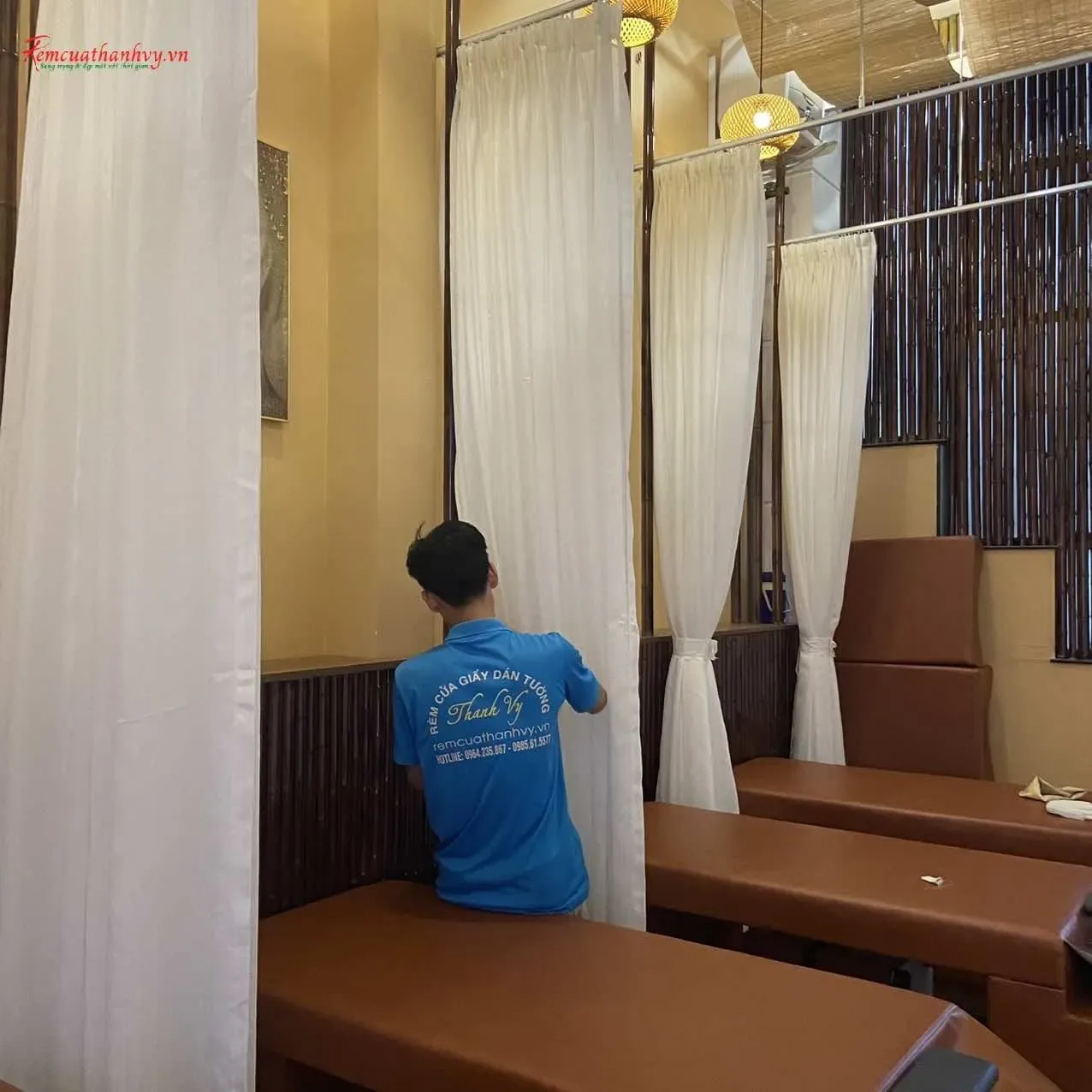
At Leblanc spa, the solution was a traditional single-layer fabric curtain in a light gray-beige tone, with panels hung parallel to divide the areas. This approach was simple but did the job: the woven fabric was dense enough to block views, the neutral color did not compete with the treatment room’s soft lighting, and when drawn, the panels remained evenly spaced rather than bunching together.
At Thy Nhiên spa, the bed-partitioning problem was solved by combining two things: string curtains and thin sheer curtains in white, beige, and dark brown, accented with gold fibers. The space here included a showroom, customer service rooms, and soaking rooms, with each area requiring a different level of coverage, so combining the two materials was about assigning roles, not decorating for its own sake.
The two projects were the same type of business and in the same district, yet they made opposite choices in materials. That shows that the deciding factor is not the spa label, but how much coverage each area inside that spa requires.
String curtains really are beautiful, but do not confuse them with a privacy solution
The string curtains at Thy Nhiên spa were the most praised detail visually: the strands hung evenly, did not twist, formed a symmetrical composition, and caught the light beautifully under the decorative lighting. But if you look only at the photos and conclude that string curtains are a solution for partitioning treatment beds, you would be mistaken.
String curtains are a visual boundary, not a covering. They tell people passing by that someone is using the area, soften the dividing line, and create depth. They do not block light or views in the way a fabric panel can. Precisely for that reason, they do not stand alone in this project: the parts requiring privacy were assigned to the sheer layer and the layout, while the string curtains played an aesthetic and space-dividing role.
If a spa wants customers to change clothes or receive treatments behind a curtain and hangs only string curtains, that is choosing the wrong tool. In this case, it would be better to follow Leblanc’s approach.
Send your dimensions and needs, and the Thanh Vy Curtains team will advise on options and quote for your actual space.
Medical curtains in Tây Thạnh: when hygiene matters more than aesthetics
The fourth project was blue medical curtains at Quốc Ánh Hospital, Tây Thạnh. The site was a multi-bed ward, with an industrial-style ceiling featuring a suspended cable system, half-height walls clad in white tile, and a ceramic floor.

Here, every choice was dictated by function. The curtains run on a ceiling-mounted track system, so they follow the shape of each bed rather than the windows. Satin-faced fabric was chosen because its surface is less prone to collecting dirt and can be wiped down and disinfected, not because it drapes beautifully. Blue is a familiar convention in healthcare environments, easy to identify and able to withstand being seen every day. The stopper at the end of the track is also a safety feature, not an accessory. Interested readers can view the Báo An Giang article about Thanh Vy premium fabric curtains.
This project shows one thing most clearly: when the need is hygiene and operation, the criteria for choosing curtains are almost completely reversed compared with a home. What is considered an advantage in a living room, such as thick fabric with many folds, becomes a nuisance here.
If your home is in the surrounding area, the Tây Thạnh ward curtains page is where you can check the measuring and installation schedule for the new address.
The track determines more than the fabric
Looking at all four projects together, what recurs across all four is not the fabric type but the hanging system. The apartment uses a near-ceiling track for the large window. Leblanc uses hanging locks to keep the panels parallel. Thy Nhiên uses a hanging frame that must be sufficiently rigid to keep the string curtains from becoming uneven. The hospital uses a ceiling track with an end stopper.
This is the part customers ask about least when getting a quote, and also the part that fails first when the work is done carelessly. Poor fabric is immediately visible at acceptance. A weak track still looks good on handover day, then a few months later begins to show heavy pulling, misaligned panels, and detached mounting points. For partition curtains in spas or hospitals, where the curtains are pulled continuously by successive customers, this is not a theoretical risk.
The takeaway is quite simple: when comparing two quotes, ask carefully about the track, the ceiling mounting points, and how the plasterboard ceiling will be handled, rather than comparing only the price per meter of fabric.
Three recurring mistakes when ordering curtains in this area
The first is bringing residential standards into a business space. Thick fabric, numerous folds, and elaborate trim may look luxurious in a living room, but in a treatment room where the curtain is pulled dozens of times a day, the fabric edge quickly wrinkles and the track bears more load than necessary.
The second is doing the opposite: bringing industrial-style partition curtains into the home because they are said to be durable and easy to clean. The result is usually a living room that looks dry, flat, and lacking in depth—the exact outcome avoided by the pleated curtain set in the apartment project mentioned above.
The third is choosing based on photos while overlooking the color and lighting context of your own room. These four projects use four different color systems, and each was chosen according to what was already present on site rather than according to trends.
What these four projects do not answer
The limitations of the article should be stated clearly. The sample includes only four projects and is heavily skewed toward commercial spaces, so there is no basis for concluding what problems townhouses or tube houses in Tân Phú commonly encounter. The only residential project is a high-floor apartment, which does not represent the other types of homes in the district.
The data also contains no information about the sun-facing direction of each project, so any statement that a home facing a certain direction should use a particular curtain would be speculation. Similarly, there are no records of conditions after a period of use, so this article makes no claims whatsoever about durability over the years.
Finally, all four projects were rated well in terms of installation. A collection consisting entirely of good results can tell us a great deal about how to do things correctly, but very little about what fails when the work is done incorrectly. Read this article as four specific examples, not as a statistical study.
Which question should you start with when choosing curtains in Tân Phú?
The first question is not which curtain looks beautiful, but whether this curtain is dividing a space or treating a window. Answering that question eliminates half of the wrong choices.
The second question is how much coverage is needed: do you only need to block the view, or do you need to block out the light as well? String curtains, sheer curtains, single-layer fabric, and one-way fabric sit at four different levels, and lumping them all together as curtains is the source of most disappointments after installation. Background information about polyester fibers in the textile industry helps with comparison when choosing materials.
The third question is how often the curtains will be opened and the cleaning conditions, because these determine the track and material more than they determine the color. After those three questions, all that remains is to measure the existing window and ceiling on site. Nearby areas can also be viewed at curtains in Tân Sơn Nhì Ward and curtains in Phú Thọ Hòa Ward.
Quick answer: The four projects Thanh Vy completed in Tân Phú were mainly space-dividing curtains for spas and hospitals, with only one being an apartment. The clearest lesson is that the track system and the required level of coverage determine the result more than the type of fabric, while these four projects are not enough to say anything about townhouses in the district.
For further information, please contact Thanh Vy Curtains
We provide free consultation and on-site measuring at your home.

Related projects
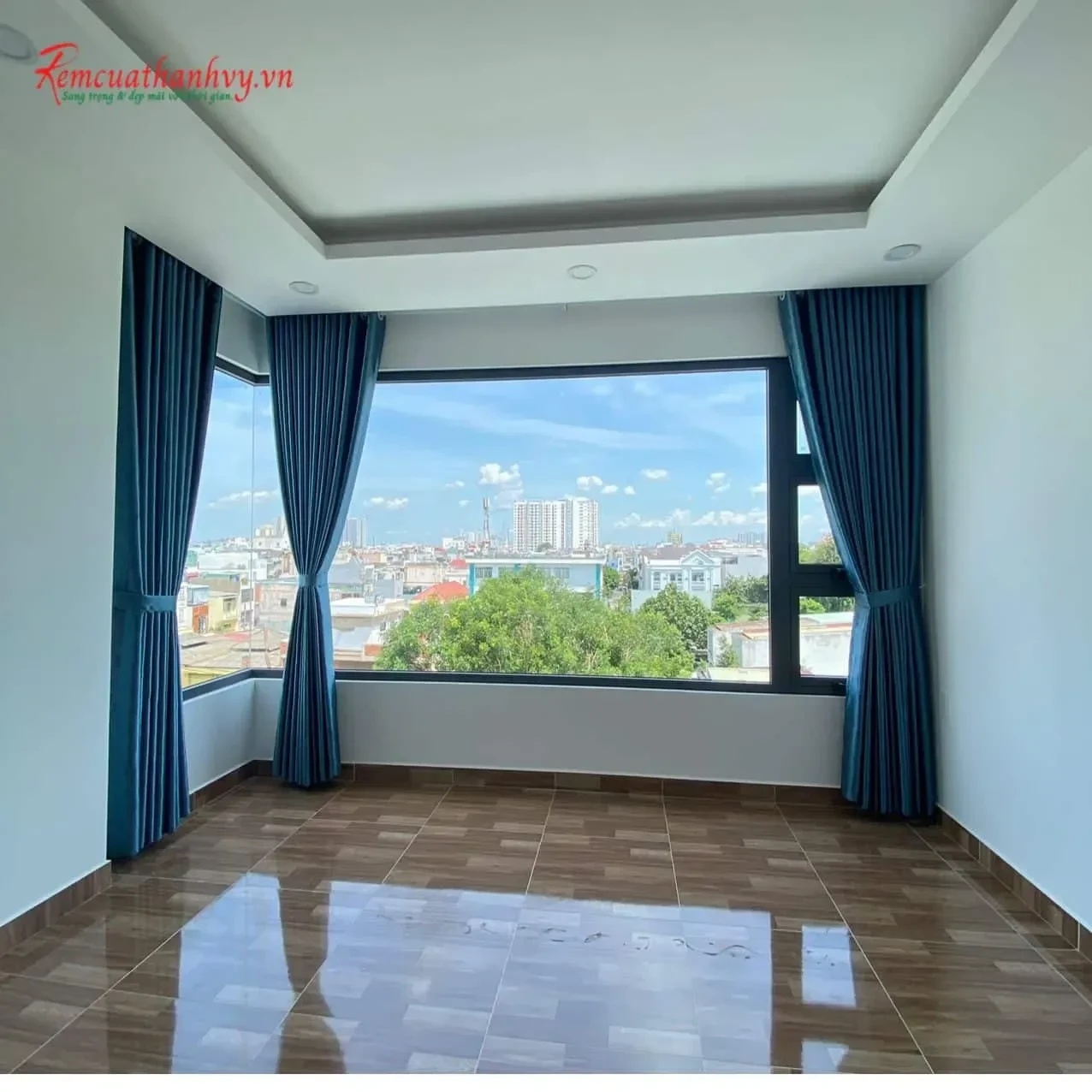
Blue Fabric Curtains for a High-End Apartment Living Room in Tân Phú District
This project involved the living room of a high-rise apartment in Tân Phú District, Ho [...]
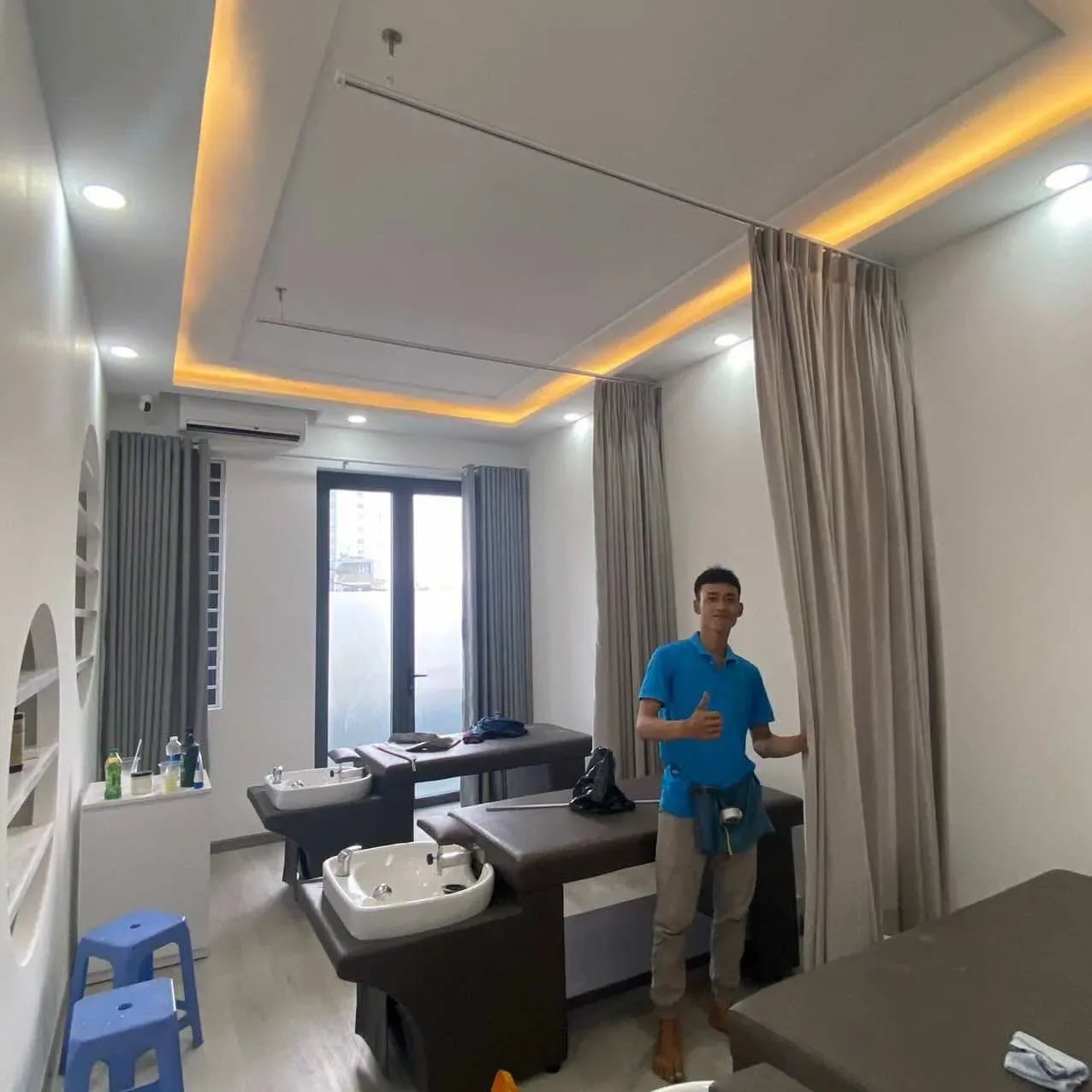
Leblanc Spa Fabric Divider Curtains – Tan Phu District
The curtain project carried out by Thanh Vy Curtain at Leblanc Spa (Tan Phu District, [...]
String Curtains & Sheer Curtains for Thy Nhien Spa Tan Phu – Premium Bed Dividers
The Thy Nhien Spa project in Tan Phu District was an upgrade to a premium [...]
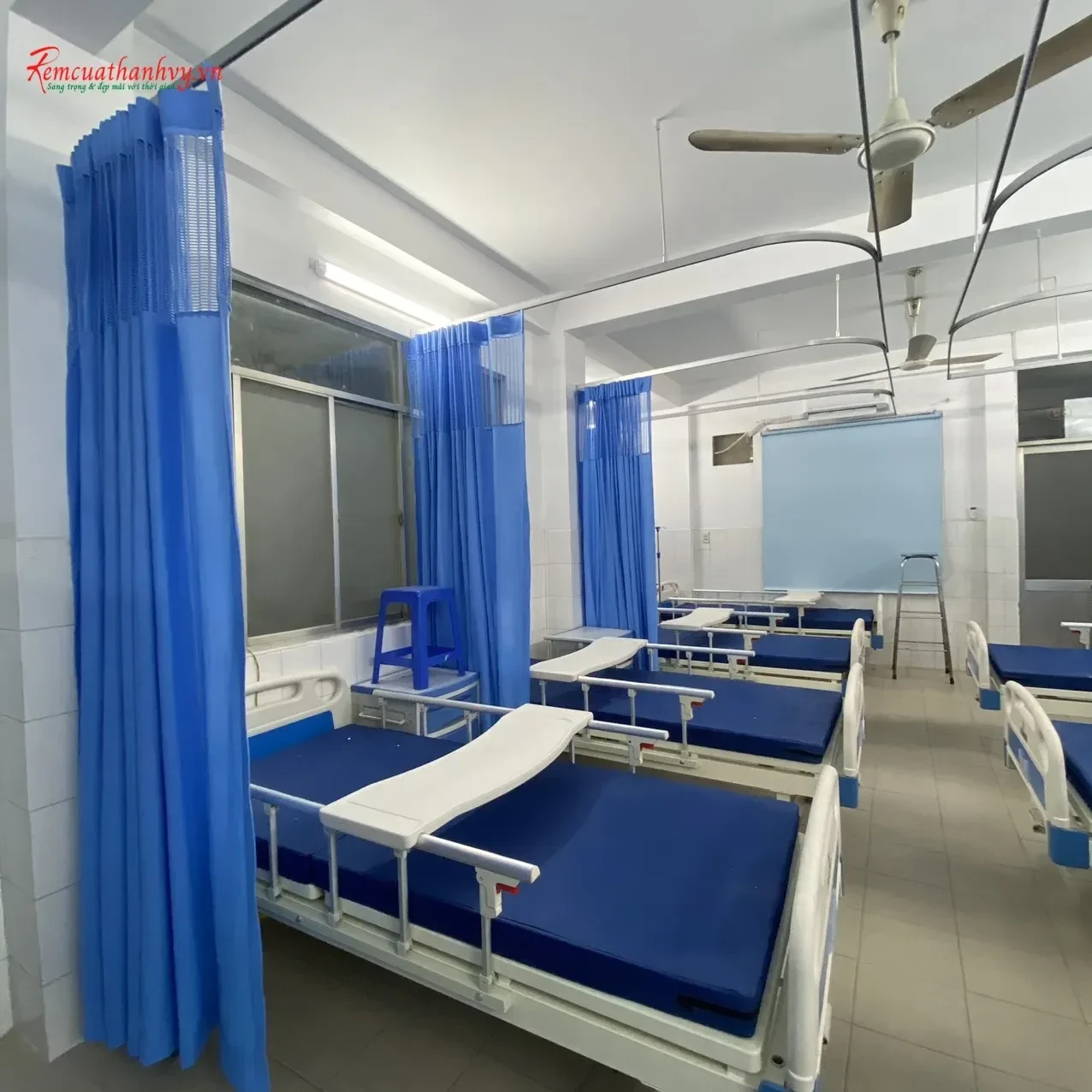
Blue Sliding Medical Curtains – Quoc Anh Hospital, Ho Chi Minh City
In 2024, Thanh Vy Curtains completed a medical curtain installation for a multi-bed ward at [...]
Related areas
Tan Phu Curtains: How to Choose Based on Your Needs and Existing Windows
A guide to choosing Tan Phu curtains based on light, privacy, installation style, stacking space, [...]
Curtains in Tay Thanh Ward, Tan Phu: on-site measurement and installation at your new address
Curtain measurement and installation in Tay Thanh Ward, Tan Phu. The ward was merged from [...]
Curtains in Tan Son Nhi Ward, Tan Phu: On-site measurement and installation at new addresses
Curtain measurement and installation in Tan Son Nhi Ward, Tan Phu. The ward was newly [...]
Curtains in Tan Phu Ward, Tan Phu District: On-site measurement and installation at your new address
Curtain measurement and installation in Tan Phu Ward, Tan Phu District. This is a new [...]
Curtains in Phu Tho Hoa Ward, Tan Phu: On-site measurement and installation at the new address
Curtain measurement and installation in Phu Tho Hoa Ward, Tan Phu. The ward was newly [...]
Curtains in Phu Thanh Ward, Tan Phu: On-site measurement and installation for new addresses
Curtain measurement and installation in Phu Thanh Ward, Tan Phu. The ward was newly merged [...]
Curtains in Tan Binh: What to Prioritize for Each Space
Customers in Tan Binh should note the importance of choosing curtains that suit the sun's [...]
Linen curtains in Binh Tan: Choosing the right Nordic style for every space
When choosing curtains in Binh Tan, it is essential to carefully consider sun-blocking materials and [...]


No comments yet!